The five things a founder should stop doing after closing a seed round
Closing your seed isn't the finish line. It's the starting gun for a completely different kind of company — one that most founders aren't immediately equipped to run.
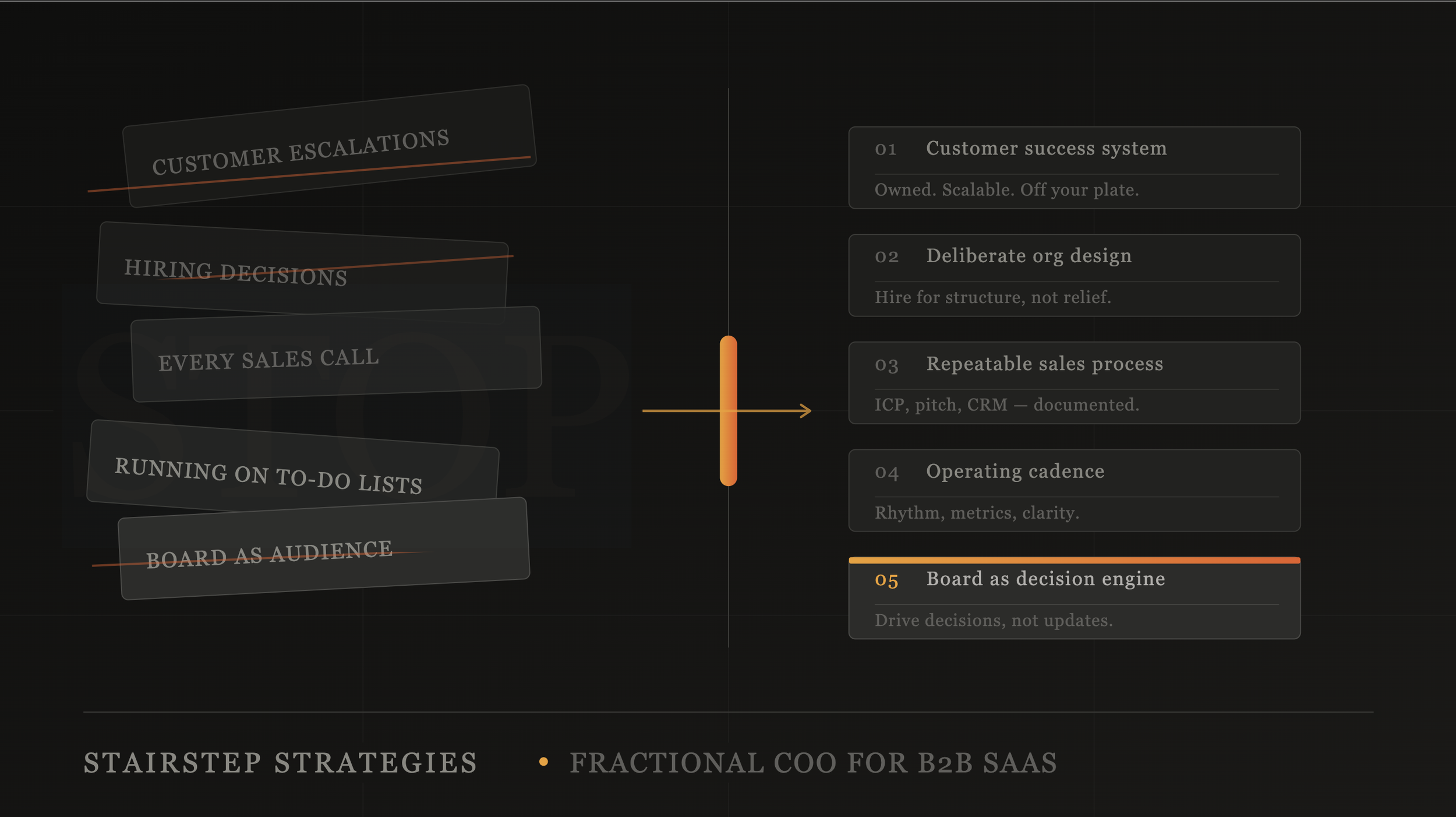
There's a particular kind of chaos that sets in at the pre-seed to seed transition. The company now has money in the bank. It has a handful of early customers. It might even have a few hires in place. But the founder is still running everything the way they did when it was just them and a laptop — because that's what worked, and because no one has told them it's time to stop.
What got you here will not get you there. That's not a platitude. It's a description of a very specific operational trap that catches a large percentage of seed-stage SaaS founders, and it shows up in five distinct patterns.
01
Stop being the first responder for every customer issue
In the pre-seed phase, founders being deeply embedded in customer issues is an asset. It produces the product insight you can't get any other way, and it signals to early customers that they matter. That season has value — and it ends.
After closing a seed round, the founder as first responder becomes a liability. It creates a single point of failure for customer relationships. It prevents the company from building a repeatable success process. And it costs the founder the time and cognitive space they need to operate at the level the company now requires.
The goal at this stage isn't to stop caring about customers. It's to build a customer success operation that cares about them at scale — with clear ownership, defined handoffs, and the founder stepping back from the inbox.
If you're still the primary point of contact for more than one or two strategic accounts six months after closing your seed, that's a structural problem, not a personal preference.
02
Stop hiring reactively
Seed-stage hiring often follows a familiar pattern: a function becomes overwhelmed, the founder feels the pain acutely, and a hire gets made to relieve that specific pressure. Repeat. The result is a team assembled from a series of emergency decisions rather than a deliberate org design.
This produces several downstream problems. Roles overlap in ways no one mapped out. Accountability is ambiguous. And the company ends up with a structure built around the people who were hired, rather than people hired for a structure that supports where the company is going.
After closing a seed round, hiring needs a thesis behind it. That doesn't mean a complex org chart — it means the founder should be able to articulate the logic behind each hire: what function it covers, what that person will own, and how the role connects to the company's operating plan for the next 12–18 months.
Reactive hiring feels fast. It tends to be the most expensive thing an early-stage company does when it goes wrong.
03
Stop running sales as a personal relationship sport
Many seed-stage B2B SaaS founders close their first ten to twenty customers on the strength of their network, their credibility, and their ability to walk into a room and make something happen. That's real — and it's not scalable.
A founder-led sales motion that isn't being systematically converted into a repeatable process is a ticking clock. When the founder's attention goes elsewhere — and after a seed round, it will — the pipeline doesn't just slow down. It stops, because no one else knows how to replicate it.
The work after closing a seed round isn't to stop selling. It's to document what's working: the ICP, the pitch, the objection responses, the sequence of conversations that leads to a close. It's to build a CRM that reflects reality rather than existing for compliance. And it's to start transferring the sales motion to people and systems that don't require the founder's personal involvement on every deal.
The pipeline you close yourself doesn't prove you have a sales process. It proves you can sell. Those are different things, and investors know the difference.
04
Stop running the company from a to-do list
A to-do list is a productivity tool. It is not an operating system. There's a meaningful difference between a founder who is busy and a founder who is running a business — and that difference becomes visible fast once a team starts forming around them.
After closing a seed round, the company needs a basic operating cadence: a weekly rhythm that keeps the team aligned, a planning process that converts strategy into workable priorities, and a metrics structure that tells the founder what's working and what isn't before it becomes a crisis.
None of this has to be complicated. A single-page operating plan, a weekly leadership sync with a consistent agenda, and three to five metrics that actually matter will do more for execution velocity than any project management tool. The goal is to move from "the founder knows what's happening" to "the company knows what's happening."
Founders who resist this often frame it as bureaucracy. What it actually is is the infrastructure that allows the company to move fast without breaking the same things repeatedly.
05
Stop treating your board as an audience
A lot of seed-stage founders walk into board meetings with a deck that tells a story about what happened over the last quarter. The board listens. There's some discussion. Everyone leaves. Three months later, the same format repeats.
That's not a board meeting. That's a presentation. And it's one of the most underutilized levers in the early-stage company's toolkit.
A board that's genuinely useful is one that's being brought into real decisions — not just results. That means coming in with the two or three things the company is actively wrestling with, the tradeoffs involved, and what kind of input would actually be helpful. It means having metrics that tell a story rather than just fill a slide. And it means the founder being willing to be honest about where the company is struggling, not just where it's winning.
Board meetings that drive decisions require an operating infrastructure behind them. You can't walk in with three decisions to make if you don't have the data, the framework, or the operating clarity to support the conversation. That infrastructure — the metrics, the reporting cadence, the quarterly narrative — is exactly what gets built in the months between closings.
The pattern underneath all five
Each of these five things has a common root: a founder running a seed-stage company the way they ran their pre-seed company. The instincts that produce that behavior — speed, personal ownership, bias toward action — are good instincts. They built the thing. The problem is that they tend to scale the founder, not the business.
Closing a seed round is the moment to start making that transition deliberately. Not all at once, not by adding bureaucracy, but by identifying the specific things the founder needs to stop owning personally — and building the systems, people, and structures to own them instead.
The companies that do this early go into their Series A conversations with a real operating narrative. The ones that don't spend that same conversation explaining why their metrics are lumpy, why the team keeps changing, and why the founder is still the hub of every critical decision.
The work isn't glamorous. But it's the work that turns a funded product into a fundable business.
If you recognized yourself in more than one of these, that's the signal.
Most founders don't need someone to tell them these problems exist. They need someone to help them build their way out. StairStep Strategies works alongside pre-seed and Series A B2B SaaS founders to do exactly that — not as an advisor, but as an embedded operator. If the timing feels right, let's find out.