The StairStep method: how early-stage startups build operational leverage one step at a time
Most operational frameworks assume you know what's broken. The StairStep method starts before that — with an honest look at where the company actually is before deciding what to build next.
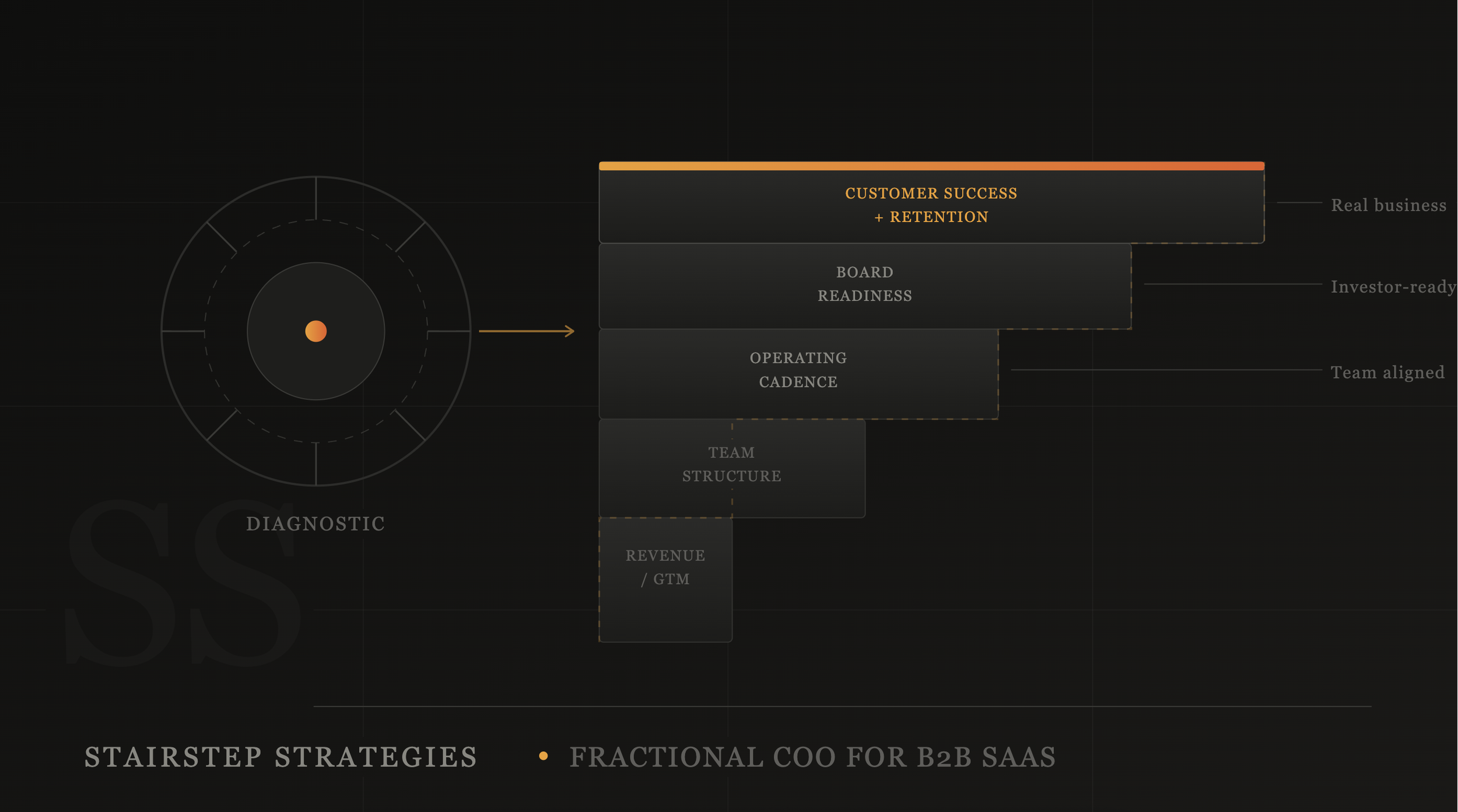
When I started working with early-stage B2B SaaS founders, the most common mistake I saw wasn't that they were building the wrong things operationally. It was that they were building in the wrong order — or building solutions to symptoms rather than root causes.
A founder would come in convinced they needed a sales process overhaul. Three conversations in, it was clear the real problem was that nobody owned customer success, which meant the sales team was spending half their time managing existing accounts instead of closing new ones. Fix the attribution, not the pipeline.
Or a founder would want to stand up an OKR framework — a legitimate goal — but the company didn't yet have the weekly operating rhythm to make goals meaningful. OKRs on top of chaos are just a more elaborate version of chaos.
The StairStep method exists because operational leverage isn't built by fixing everything at once. It's built by fixing the right thing next — and making each step solid enough to stand on before moving to the one above it.
The diagnostic comes first — always
Before any work begins, I spend time understanding the full picture of where a company is operationally. Not just the pain the founder is feeling most acutely right now, but the underlying structure — or lack of it — across the whole business.
This matters because operational problems don't present themselves honestly. What looks like a hiring problem is often a clarity problem. What looks like a revenue problem is often a retention problem showing up in the wrong place. What feels like a team alignment issue is often a metrics problem — nobody agrees on what good looks like because nobody has defined it.
The diagnostic phase asks a simple set of questions across every part of the business outside of engineering and product: what's owned, what's documented, what's repeatable, and what lives entirely in the founder's head. The answers to those four questions tell you almost everything about where the leverage is.
The goal isn't to find everything that's broken. It's to find what's broken in a way that's blocking everything else — and start there.
The five areas of operational leverage
The StairStep method covers five operational areas. Every engagement touches all five eventually — but the sequence and depth of focus in each one is different for every company, because the gaps are always different.
Here's what each area covers and why it matters at the pre-seed and Series A stage:
Area 01: Revenue operations and go-to-market infrastructure
The systems and processes that make sales and marketing repeatable — ICP definition, pipeline structure, CRM integrity, handoffs between functions, and the reporting that tells you what's working before you've spent six months doubling down on the wrong thing. Founder-led sales is fine at pre-seed. It's a liability if it's still fully founder-dependent at Series A.
Area 02: Team structure and hiring
Not recruiting — the strategic layer behind it. When to hire, who to hire, how to structure roles so they don't create ambiguity and overlap as the company scales. The org design decisions made at ten people tend to calcify. Getting them right early is significantly cheaper than untangling them at thirty.
Area 03: Operating cadence and internal clarity
The weekly and quarterly rhythms that keep a team aligned without the founder being in every room. Meeting structures, goal-setting frameworks, decision-making norms — the scaffolding that lets a company move fast without the same things breaking repeatedly. This is unglamorous infrastructure. It's also where most early-stage operational debt originates.
Area 04: Board and investor readiness
The metrics infrastructure, reporting cadence, and operating narrative that make board meetings useful and fundraising conversations credible. Most seed-stage founders walk into board meetings with a deck. The ones who walk in with a clear operating narrative — and two or three real decisions to make — have a fundamentally different relationship with their investors.
Area 05: Customer success and retention operations
The processes that keep customers long enough for the SaaS model to actually work — onboarding, success milestones, health scoring, and renewal. In most early-stage SaaS companies, this function is the least structured and the most consequential. Leaky retention compounds quietly. By the time it shows up in the metrics, it's been bleeding for months.
Why the sequence matters
The method is called StairStep for a reason. Each step creates the foundation for the one above it. You can't build a reliable operating cadence if nobody owns the functions that need to show up in that cadence. You can't build an investor-ready metrics narrative if the underlying revenue operations aren't producing consistent, trustworthy data. You can't hire effectively into a structure that hasn't been designed.
This is why the sequence of work is determined by the diagnostic, not by a fixed playbook. Two companies at identical stages with identical headcounts can have entirely different starting points — and entirely different next steps — depending on what their operational picture actually looks like.
What the method provides isn't a rigid sequence. It's a way of thinking about operational priority that starts with an honest assessment, identifies the highest-leverage next step, builds that step properly, and then moves to the one above it. Repeat until the company has a real operating foundation — and the founder is no longer the single point of failure holding it together.
What the company looks like on the other side
By the time an engagement wraps, the companies I work with have gone through a specific kind of transition. The founder has stepped out of the operational day-to-day — not because they've stopped caring, but because the business no longer requires their personal involvement to function. Growth is repeatable rather than heroic. The team is aligned without constant intervention. And the Series A conversation, when it comes, is backed by an operating narrative that holds up to scrutiny.
That transition doesn't happen all at once. It happens one step at a time — each one building on the last, each one making the next one possible. That's the method. That's the point.
The goal was never to make the company more organized. It was to make it a real business — one that works when the founder isn't in the room.
Want to see what the first step looks like for your company?
Every StairStep engagement starts with a diagnostic — a clear-eyed look at where your company is operationally and what the highest-leverage next move actually is. If you're pre-seed or Series A, building a team, and feeling the gap between where the company is and where it needs to be, that conversation is a useful place to start.