What a fractional COO actually does (and what they don't) at a B2B SaaS startup
At some point after closing a seed round, most B2B SaaS founders hit a version of the same wall. Revenue is coming in. The team is growing. The product works. And yet the company feels harder to run than it did six months ago — not easier. Decisions are slower. Things fall through the cracks. The founder is busier than ever and somehow less sure about whether the right things are getting done.
That feeling has a name. It's what happens when a product-first company hasn't yet become an operating company. And it's exactly the problem a fractional COO is built to solve.
This piece is a plain-language breakdown of what the role actually covers — and what it doesn't — so founders can make a clear-eyed decision about whether it's the right move at this stage.
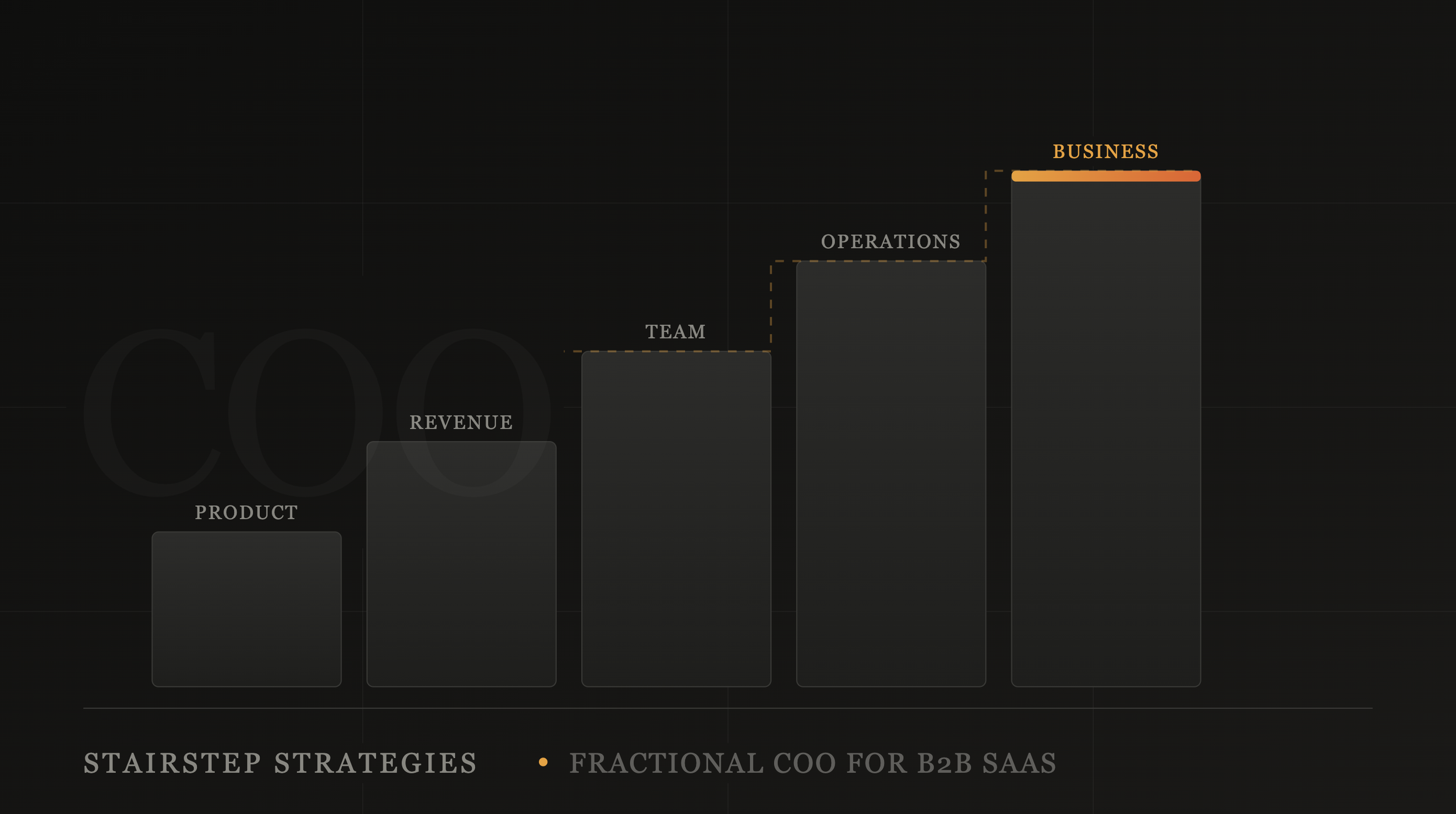
The short version: a fractional COO turns a product-first company into an operating company
Most early-stage B2B SaaS startups are built by founders who are exceptional at product and vision. What they're often not equipped for — and shouldn't be expected to be — is running the business behind the product. The systems. The people structure. The revenue operations. The processes that make growth repeatable rather than heroic.
A fractional COO steps into that gap. They work across the business — typically excluding engineering and product — to build the operational foundation that allows the company to scale without the founder holding everything together personally.
The outcome isn't just efficiency. It's the difference between a startup that has a great product and a startup that has a real business.
What a fractional COO actually does
The scope varies by company, but at a pre-seed or Series A B2B SaaS startup, the work typically falls into five areas:
Revenue operations and go-to-market infrastructure. This means building the processes, systems, and reporting that make the sales and marketing motion repeatable. Pipeline structure, CRM hygiene, conversion tracking, handoffs between marketing and sales — the plumbing that most founders ignore until it's causing them to lose deals they should be winning.
Hiring and team structure. Not recruiter work — strategic decisions about when to hire, who to hire, and how to structure roles so they don't create problems as the company grows. A fractional COO helps founders think through the org design questions that tend to become expensive mistakes if left until Series A or B.
Operating cadence and internal clarity. Weekly rhythms, quarterly planning, goal-setting frameworks — the structural elements that keep a team aligned without requiring the founder to be in every room. This is one of the least glamorous parts of the job and one of the highest-leverage.
Board and investor readiness. At the seed and Series A stage, a lot of founders are presenting to their boards without a real operating narrative behind the numbers. A fractional COO helps build the metrics infrastructure and the storyline — so board meetings drive decisions instead of just delivering updates.
Customer success and retention operations. In SaaS, the business model only works if customers stay and expand. Building the processes around onboarding, success milestones, and renewal is operational work that lives outside product and engineering — and it's frequently where early-stage SaaS companies quietly bleed.
The common thread across all of it: a fractional COO builds things that work when the founder isn't in the room. That's the job.
What a fractional COO doesn't do
They don't own product or engineering. The fractional COO is not a CTO, a VP of Product, or a technical advisor. The product roadmap, the tech stack decisions, the engineering team — that's separate territory. The best fractional COOs understand product well enough to work alongside those functions, but they don't own them.
They don't replace a full-time hire indefinitely. Fractional is a bridge, not a permanent solution. The goal is to build operational infrastructure, develop internal capability, and set the company up to hire a full-time COO or VP of Operations when the stage is right. A good fractional COO should be working themselves out of a job.
They don't make the founder's decisions for them. A fractional COO brings frameworks, patterns from other companies, and an outside perspective. But the hard calls — culture, values, strategic pivots, key hires — still belong to the founder. The operator's job is to make those decisions easier to make and easier to execute, not to make them on the founder's behalf.
They're not a management consultant. The distinction matters. A fractional COO is embedded. They do the work, not just the analysis. They build the spreadsheet, run the hiring process, sit in the pipeline review, and own outputs — not recommendations.
How fractional differs from full-time at this stage
The obvious difference is cost. A full-time COO at a Series A company might run $180–250K in salary plus meaningful equity. A fractional engagement runs a fraction of that, with flexible scope. But framing this as a budget decision undersells the real argument — and misses why full-time is often the wrong tool entirely at the seed stage, not just a more expensive one.
Here's the actual problem with hiring a full-time COO too early: you don't yet know what you need them to do. The operational gaps at a 10-person company look very different from the ones at a 40-person company. Hire a full-time COO before you've figured out what your operating model actually is, and you'll either overpay for someone to do work that doesn't yet exist — or you'll shape the company around their particular skill set whether it fits or not. Either way, you're locked in.
A fractional COO brings something a full-time hire at this stage almost never can: pattern recognition across many companies going through the same transition at the same time. They've seen which operational problems are stage-specific and will resolve on their own, which ones need to be solved now before they compound, and which ones look urgent but aren't. That perspective is genuinely hard to buy full-time, because the people who have it aren't usually available for a single 10-person startup.
The question isn't "can we afford a full-time COO?" It's "do we actually need one yet — or do we need the outcome a fractional engagement delivers first?"
Signs your startup is ready for one
Not every company at this stage needs a fractional COO. But there are specific signals that suggest the timing is right:
The founder is involved in every significant decision, and that's starting to become a bottleneck rather than a feature
You've closed a seed round and are starting to build a team, but don't have a clear operating structure yet
Revenue is coming in, but the process for generating and retaining it isn't repeatable
You're six to twelve months from a Series A conversation and your metrics infrastructure isn't investor-ready
You've hired a few people but roles are blurry, accountability is informal, and the team is pulling in slightly different directions
None of these are failures. They're the predictable growing pains of a product-first company trying to become an operating company. A fractional COO is built to accelerate that transition — without the overhead of a full-time executive hire before the company is ready for one.
The bottom line
A fractional COO is an embedded operator — not an advisor, not a consultant, not a part-time manager. At a B2B SaaS startup, their job is to build the infrastructure, processes, and rhythms that allow the company to grow without the founder becoming the permanent bottleneck.
They don't replace product leadership, make the founder's calls, or stay forever. What they do is close the gap between "we have a product" and "we have a business" — at the stage when that gap tends to be widest and most costly.
If any of this sounds familiar, let's talk.
StairStep Strategies works with pre-seed and Series A B2B SaaS founders who are ready to build the operating infrastructure behind their product. If you're six to twelve months from a fundraise, growing a team, or just feeling the gap between where the company is and where it needs to be — a single conversation is a useful place to start.